Packages
One page per package, in pipeline order. Each covers what the stage does, the mental model behind it, the types it hands the next stage, and the decisions it makes on your behalf.
For exhaustive signatures, types, defaults and exceptions, see the Complete API Reference — it is generated from the code and cannot drift.
The architecture
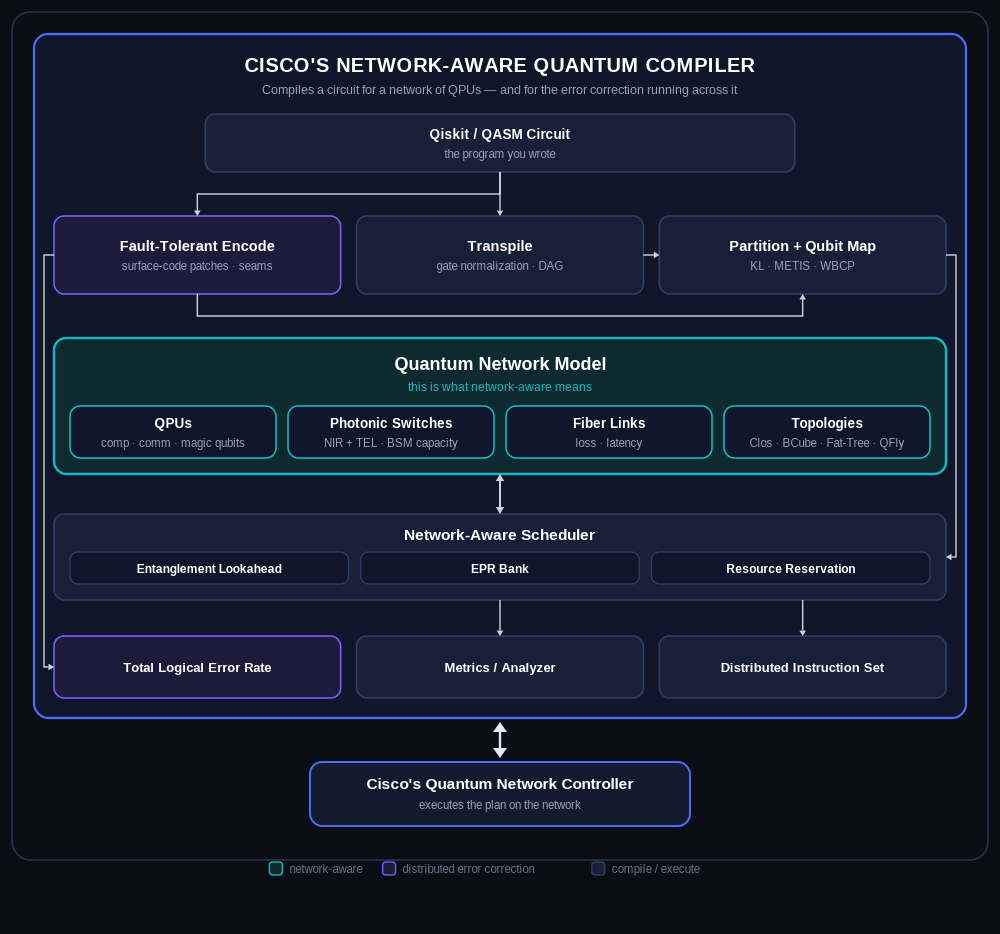
The circuit runs down the left. The network model on the right is read by three of the four stages — that sharing is what "network-aware" means in practice, and it is why the partitioner and the scheduler cannot disagree about the hardware they are planning for.
Core pipeline
-
Load a Qiskit circuit, or build one from the benchmark library: QFT, TFIM, Grover, GF(2ᵐ) arithmetic, quantum volume and more.
-
Normalize gates and produce the graph representations every later stage reads — the DAG and the qubit interaction graph.
-
The datacenter model. QPUs, switches, links and individual qubits in one graph, with hardware characteristics attached.
-
Decide which circuit qubit runs on which QPU, minimizing the entanglement traffic between machines.
-
Step the partitioned circuit through the network against finite resources, producing a timed event log.
-
Surface-code layout, seam modelling, magic-state factories, and the Total Logical Error Rate that prices a whole run.
Around the edges
-
Many jobs, one shared topology. Reports makespan and wastage.
-
Passive metrics collection, dataframes, and multi-run comparison plots.
-
Emit a runnable distributed circuit with explicit entanglement gates, rather than stopping at metrics.
-
ILP rack placement, learned circuit/network embeddings, the HTTP service, and shared utilities.
What each stage hands the next
Knowing the types makes the pipeline easy to reason about, and makes it obvious where a custom implementation can be dropped in.
| From | Type | To |
|---|---|---|
circuit |
QiskitCircuit or a raw Qiskit QuantumCircuit |
transpile |
transpile |
TranspiledCircuit |
partition |
quantum_network |
QuantumNetwork |
everything downstream |
partition |
PartitionResult |
simulator, compile |
quantum_error_correction |
PartitionResult (with seams identified) |
simulator |
simulator |
SimulationResult |
analysis, tler() |
quantum_error_correction |
TlerResult |
you |
Most stages accept the looser type too: a Partitioner will take a
QiskitCircuit or a bare QuantumCircuit and transpile it for you. Passing
a TranspiledCircuit explicitly is worth it when you want to inspect the
DAG or reuse it across several partitioners.
Extension points
Three abstract base classes, each with shipped implementations you are meant to replace:
| ABC | Implementations | Override to change |
|---|---|---|
Partitioner |
KernighanLinPartitioner, MetisPartitioner, WindowBasedCircuitPartitioner |
How qubits map to QPUs |
Simulator |
StaticScheduler, DynamicScheduler, DQCScheduler |
How execution is scheduled |
EprDelivery |
FixedIdleEpr, PoissonEpr |
How entanglement delivery enters the error model |
A new EprDelivery is a new threshold table and a new key, not a new code
path — which is the property that keeps the error budget from growing a
branch per model.