
What is quantum networking?
A guide to the infrastructure behind the quantum internet
Updated on
What is quantum networking? A guide to the infrastructure behind the quantum internet
Every major leap in computing begins with the same challenge: the problems to solve eventually outgrow the systems that exist to solve them.
That challenge is becoming increasingly apparent as organizations are experiencing the limits of classical computing. As the demand for computational power increases, simply adding more processors, servers, or infrastructure is no longer enough to solve complex problems that are impractical for classical systems. The quantum computing industry is in a race to build bigger machines. But building bigger is not the only path forward. A second challenge, and the one that could determine whether quantum computing reaches practical scale, is how to connect quantum computers to one another.
At Outshift, we believe that the solution requires more than powerful computers; it requires a fundamentally new way of connecting them. That is quantum networking, and it is where the next phase of the industry is being shaped.
What is quantum networking?
Quantum networking is the infrastructure—hardware, software, protocols, and application—that connects quantum computers and devices, allowing them to share quantum information, primarily through quantum entanglement. While classical networks physically transport digital information (the binary bits, 0s and 1s), quantum networks generally do not move the information itself. Instead, they teleport quantum states, or qubits.
That single difference is what enables secure communication, distributed quantum computing, and the emerging quantum internet.
This capability is becoming increasingly important as quantum computing advances. While much of the industry's attention is focused on building larger and more powerful quantum processors, a fundamental challenge remains. Quantum systems contain hundreds to thousands of qubits, while many of the most impactful applications of quantum computing are expected to require thousands to millions.
This raises the question: if it’s not possible to build infinitely larger quantum computers, how can scale be unlocked to achieve quantum computing's full potential?
The answer may look surprisingly familiar—by connecting systems together. When a single machine was no longer enough, networks transformed isolated computers into data centers, cloud platforms, and ultimately the internet itself.
Quantum computing is approaching a similar inflection point. Rather than relying solely on larger processors, the future of quantum computing will depend on connecting quantum computers into distributed networks capable of sharing resources, distributing workloads, and performing computations that no single machine could achieve alone.
Ramana Kompella, VP and Head of Cisco Research, which includes the Cisco Quantum Labs, explains the present-to-future vision: "The quantum industry today is exactly where classical computing was in the 1960s: relying on isolated machines. To reach their true potential, quantum processors must be networked. By architecting an open, interoperable fabric, we are accelerating the quantum timeline and delivering immediate, physics-based value to infrastructure today."
This is the role of quantum networking: the technology that connects quantum computers and quantum devices so they can share quantum information and operate as part of a larger computational system.
Achieving this future requires a full quantum network of hardware, protocols, and a software layer built specifically for the rules quantum information obeys. Before those layers make sense, it helps to understand the physics they are built around.
What is quantum computing, and how does it work?
Quantum computing uses the properties of quantum mechanics to process information in ways a classical computer cannot. A classical computer manipulates bits, each locked to a definite value of 0 or 1. A quantum computer manipulates qubits, which can hold a blend of both values at once and can be linked together so that their states are correlated.
Quantum computing is not intended to replace classical computing. Rather, it serves as a specialized computational resource for solving high-dimensional problems involving optimization, simulation, modeling, and coordination.
The future of quantum and classical computing is thought to be more of a hybrid solution, combining the strengths of both. As Vijoy Pandey, Outshift’s Senior Vice President explains:
"The answer is not just building bigger quantum computers, it's also connecting them. A distributed approach, where many quantum processing units are unified through a quantum network, will help us get to useful quantum computing with added efficiency."
Classical computing vs. quantum computing fundamentals
To understand how quantum computing works, it is helpful to think of it in the context of classical computers and applications. If classical computing is like testing keys on a lock one by one, quantum computing is like testing many keys at once and letting the lock itself guide you toward the right fit.
Bits vs. qubits:
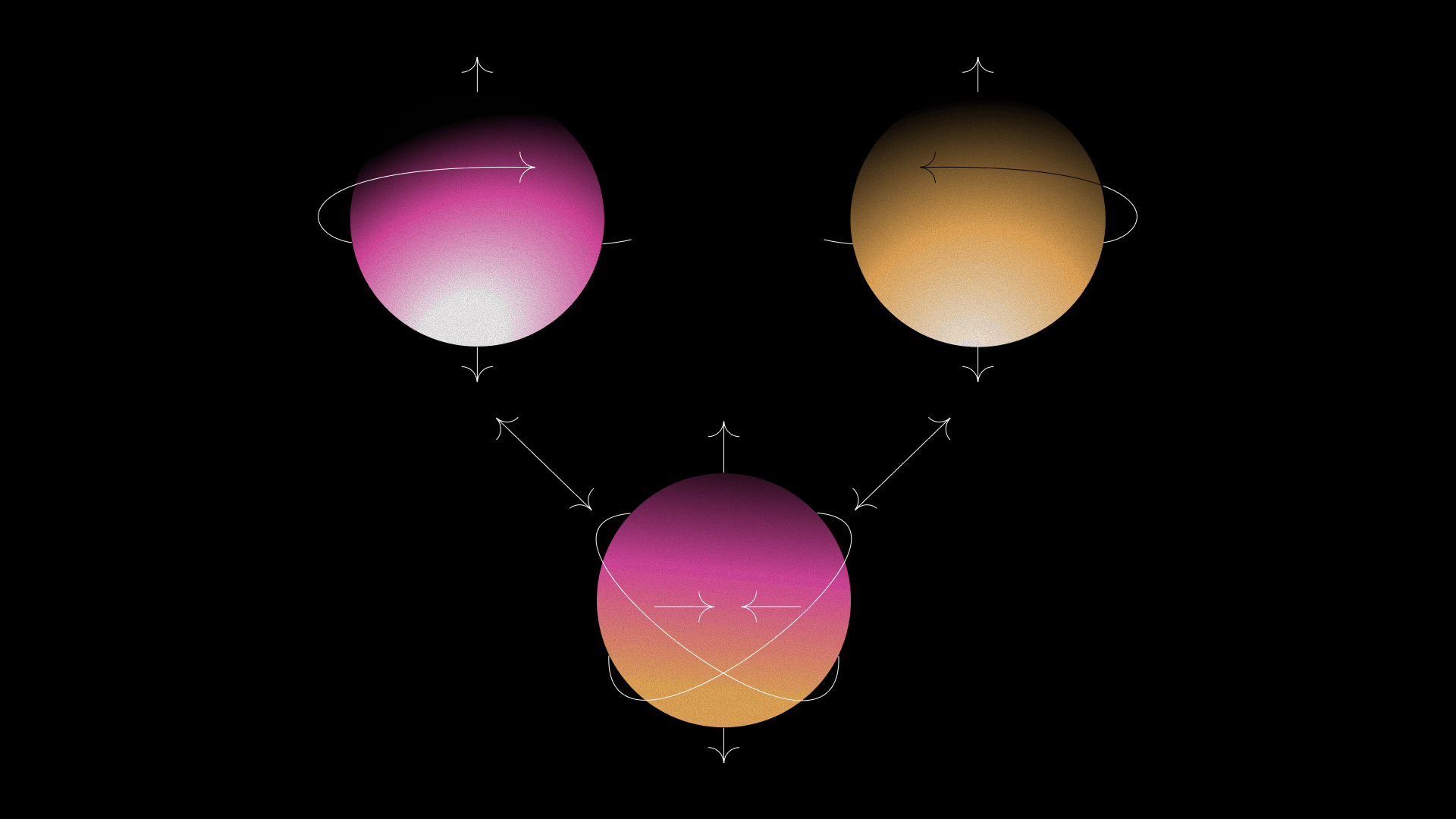
- Classical computers process information sequentially using a binary system of bits, which exist in a definite state of either 0 or 1, much like a light switch that is either on or off.
- Quantum networks transmit qubits, the foundational unit of quantum computing, which leverage superposition to hold both 0 and 1 as possibilities at the same time until they are measured or observed.
Deterministic vs. probabilistic:
- A classical computer is deterministic. Given the same input and the same program, it follows one fixed path to one fixed output, every time. This predictability is the foundation of everything classical computing does well, from spreadsheets to databases to the software running the device you are reading this on.
- A quantum computer is probabilistic, which means it does not check options one at a time to find a guaranteed outcome. Instead, quantum computers explore massive numbers of possible outcomes concurrently. They arrive at solutions based on probability, using a process called quantum interference to amplify the most promising paths while suppressing the weaker, incorrect ones.
What is superposition? How a qubit can hold more than one value
Superposition is the property that lets a single qubit represent 0 and 1 at the same time, rather than one or the other. The classic image is a spinning coin. While it spins, it is neither head nor tails but a mix of both. Only when it lands (the moment of measurement) does it become one definite value.
The consequence at scale is what makes quantum interesting. Two classical bits can be in exactly one of four combinations at a time: 00, 01, 10, or 11. Two qubits in superposition can represent all four combinations simultaneously. Add more qubits and the number of combinations doubles with each one, so a modest number of qubits can, in principle, represent an enormous space of possibilities at once. A few hundred qubits can represent more states than there are atoms in the observable universe.
There is a catch that shapes the entire field. You cannot read all of those states. The moment you measure a qubit, its superposition collapses to a single value, and the rest of the information vanishes. A quantum computer is therefore not a machine that checks every answer in parallel and hands over the list. It is a machine that must be programmed so that, by the time you measure, the answer you want is the one most likely to appear.
The fragility of quantum states
Since quantum states exist in superposition, maintaining this state is extraordinarily difficult because quantum information is fundamentally fragile. This fragility is driven by three primary factors:
- Extreme environmental sensitivity (Decoherence): Qubits are highly susceptible to any environmental noise. Even minor physical disruptions—such as a tiny vibration, a slight temperature shift, or a single stray photon—can trigger a process called decoherence where the quantum state collapses, and the calculation fails. While these impairments are entirely negligible for classical signals, they are fatal for quantum states, meaning a photon could reach its destination completely stripped of its entanglement.
- The measurement problem: In the quantum realm, the mere act of observation is destructive. The moment a quantum state is measured, read, or interacted with, its superposition collapses into a definite classical, binary state of 0 or 1. Once measured, its unique quantum properties vanish forever.
- The No-Cloning Theorem: Because any measurement destroys the quantum state, quantum fragility is governed by a physical law known as the no-cloning theorem. This dictates that it is impossible to copy, clone, or amplify a quantum state without destroying the original.
Because of these factors, traditional networking methods like TCP/IP and classical optical switches are fundamentally incompatible with quantum information.
By using entangled photons to teleport fragile qubits, quantum networks are being designed to connect independent quantum computers so they can share quantum states and work together. Importantly, these networks respect the no-cloning theorem, meaning quantum information is transferred rather than copied, preserving the integrity of the quantum state.
How does quantum networking work?
Quantum networking works by creating and distributing entangled quantum states between connected quantum devices, allowing them to share quantum information across a network. Rather than transmitting data as classical bits, quantum networks use entanglement and quantum teleportation to transfer quantum states between systems. There is no way to simply copy a qubit and send the copy, because the foundational rule forbids it. Understanding that rule is the starting point for everything a quantum network does. This would then enable multiple quantum computers, sensors, and processors to operate together as a distributed platform, providing a scalable path toward larger quantum computing systems and future quantum internet applications.
Quantum Entanglement
At the heart of quantum networking is quantum entanglement.
Quantum entanglement is a unique phenomenon in quantum mechanics where two or more particles (typically photons) become intrinsically linked, sharing a joint quantum state.
When two particles become entangled, they act like "quantum twins." In this case, measuring the state of one particle immediately tells you the matching result that you’ll get from the other, no matter how far apart they are in physical distance. Albert Einstein coined this phenomenon as “spooky action at a distance.”
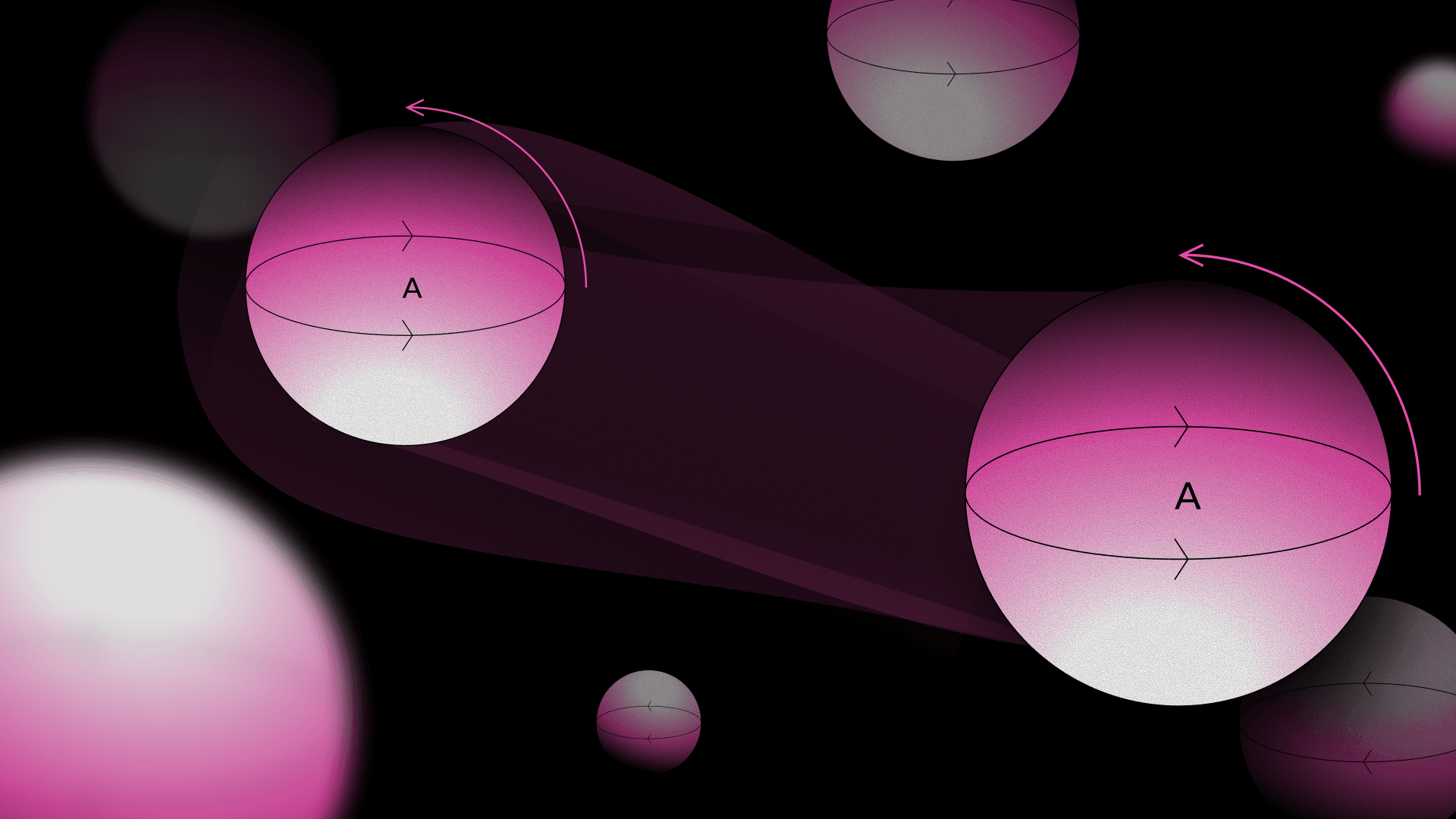
While it may seem like information is traveling faster than light, it does not actually allow for communication. Instead, it creates non-local correlations that are a fundamental property of the quantum realm and a cornerstone for modern quantum networking.
The practical challenge is not producing entanglement once, but producing it at high rates, with high fidelity, at wavelengths compatible with existing fiber, and in a device small and efficient enough to deploy. Meeting all of those conditions at once is what turns a physics experiment into networking infrastructure, and it is the specific problem Cisco’s Quantum Network Entanglement Chip is built to solve.
By distributing entangled particles across a network, geographically separated quantum processors can use this connection to "teleport" quantum information from one place to another without physically moving the data itself. This shared entanglement fabric allows independent quantum devices to share states and operate together as a single, massive computational system.
Quantum Teleportation
Classical networks move digital information by physically transmitting binary bits between devices. Whether data travels through copper cables, fiber-optic networks, satellites, or wireless signals, the information itself moves from one location to another. This process is like physically shipping a red or green flag to a destination.
Quantum teleportation is how quantum networks exchange quantum states without physically moving the information itself. Teleportation relies on classical channels to transmit measurements, which means it's still bound by the speed of light.
Instead of transmitting data directly, the network uses quantum entanglement to distribute linked "twin" photons. A sender then performs a joint measurement on their quantum data and their entangled photon, which destroys the original state but transforms the receiver's photon to carry that information. Through teleportation, the quantum state is reconstructed at the destination and destroyed at the source, moving the information without ever making a copy or physically traversing the space between them.
Picture it this way: Two people each hold a magically linked coin. To send a secret, the sender combines it with their own coin and mails the other person a short set of instructions. The instructions mean nothing on their own, but when the reader applies them to their linked coin, they recreate the sender's secret exactly, while the sender's original is destroyed in the process. Nothing about the secret travels in the mail, yet it arrives intact.
Quantum Communication
Quantum communication is the process of transferring delicate quantum states (qubits) between different physical locations. Rather than moving classical binary bits (0s and 1s) through cables, quantum communication typically uses individual photons as "flying qubits" to act as carriers of quantum information.
Quantum communication is the fundamental mechanism that allows isolated Quantum Processing Units (QPUs) to link together and operate as a quantum data center.
Instead of trying to physically move the actual computing data across distances—which is risky due to the extreme fragility of quantum states—quantum communication is primarily used to distribute "entangled photon pairs" across the network. These entangled photons serve as the carriers that allow the network to "teleport" a quantum state from a source to a destination without physically transporting the data itself.
Quantum Repeaters and Quantum Memory
To distribute quantum information over long distances, the industry must overcome a major physical barrier: exponential signal loss in fiber-optic cables. In classical networks, signal degradation is fixed by using amplifiers to simply copy and boost the data as it travels. However, due to the laws of quantum mechanics—specifically the no-cloning theorem—quantum states are too fragile to be copied or amplified without being destroyed.
To bypass this limitation, quantum networks rely on two highly specialized technologies:
- Quantum Repeaters: To bridge long distances—typically anything beyond 100 kilometers—networks must use quantum repeaters instead of classical amplifiers. Rather than boosting a signal, quantum repeaters preserve and extend entanglement across the network. They accomplish this by having intermediate nodes perform "entanglement swapping" to securely link quantum states from one point to another, effectively allowing the network to teleport the information across vast physical spaces.
- Quantum Memory: The process of distributing entanglement across a network is probabilistic, meaning it does not always succeed on the first try. Quantum memories are used to safely store and buffer these fragile quantum states until the system receives a signal confirming that the entanglement connection was successful. Quantum memory stores the successful link's state, without measuring it, until its neighbor catches up, at which point the two can be joined. Building quantum memory that holds states long enough and faithfully enough is one of the field's active hardware challenges.
What is quantum networking used for?
The vision of quantum networking is to distribute quantum information—primarily through entanglement—to connect isolated quantum computers, sensors, and devices into a unified, scalable system.
Reza Nejabati, Head of Quantum Research at Cisco, describes Cisco’s vision for quantum networking:
“Quantum networking is the foundational infrastructure technology that aims to address two critical pain points: the need to scale quantum computers for practical, impactful use cases and the limitations of classical fiber communication.”
Specifically, a quantum network will help to achieve the following:
Distributed quantum computing
Distributed quantum computing (DQC) is an architectural approach that connects multiple smaller quantum processing units (QPUs) over a quantum network so they can operate together as a single, massive quantum computer.
DQC circumvents the scaling bottleneck of quantum hardware through horizontal "scale-out" networking. It’s a similar concept to how classical computing evolved from building giant standalone mainframes to creating networked data centers filled with servers. Instead of building one impossibly large quantum processor, a distributed quantum computer establishes non-local entanglement links between multiple smaller QPUs. By distributing entanglement across a quantum network fabric, these physically separated processors can share quantum states and computational workloads, allowing them to function seamlessly as one giant machine. This combines two kinds of scaling: scaling up the qubit count inside each processor, and scaling out across many processors connected by the network. The network turns a collection of modest machines into a single, larger computational resource, and it lets that resource grow by adding nodes rather than by rebuilding one ever-larger machine. The economic case matters too, since pooling expensive quantum hardware in a controlled facility is far more efficient than replicating it everywhere.
Outshift believes that this "scale-out" approach could accelerate the arrival of practical quantum computing from decades away to just a few years, unlocking breakthroughs in fields like personalized drug discovery, advanced materials science, and complex logistics.
Quantum-secure communication
Quantum-secure communication uses the physics of measurement as a security mechanism, rather than relying only on the mathematical difficulty of a code. Because observing a quantum signal unavoidably disturbs it, eavesdropping is detectable by design. This is the foundation of quantum key distribution (QKD), in which two parties exchange an encryption key encoded in quantum states; if anyone intercepts the exchange, the disturbance reveals them, and the compromised key is discarded. Classical encryption is secure because certain math is hard to reverse, at least for now.
This distinction becomes more than academic as quantum computers advance, since a sufficiently powerful one could eventually break the public-key cryptography that secures much of today's communication.
Distributed quantum sensing
Quantum sensors are significantly more sensitive to environmental changes than classical sensors. By networking these sensors, they can work together to perform high-precision measurements
Distributed sensing represents another powerful example of how connected quantum systems create capabilities beyond any individual device. Reza Nejabati, Head of Quantum Research at Cisco explains the use cases:
"This network will connect quantum computers, scaling them to capacities of practical use. Additionally, we plan to construct a quantum network that connects quantum sensors, thereby achieving unparalleled sensing capabilities and accuracy through distributed quantum sensing. This infrastructure will also be equipped to deliver ultimate and scalable quantum-safe security for next-generation telecommunications networks, including 6G."
Securing quantum solutions
Quantum computing is not only a source of future computational power. It is also a security problem that needs to be addressed today. The central concern is the cryptographically relevant quantum computer (CRQC), a quantum machine powerful and stable enough to break the widely used public-key encryption that protects the internet. Alongside its networking research, Cisco is developing two lines of defense: post-quantum cryptography, which hardens encryption against that threat, and quantum-generated randomness, which strengthens the entropy that security depends on.
Post-quantum cryptography (PQC)
Post-quantum cryptography (PQC) is a set of classical encryption algorithms designed to resist attacks from future quantum computers. It runs on today's hardware and needs no quantum network, which is what makes it the immediate, deployable defense rather than a future one.
Its urgency comes from two threat models. Harvest Now, Decrypt Later (HNDL) is the practice of capturing encrypted data today in order to decrypt it once quantum systems mature, which endangers long-lived secrets such as personal identifiers, financial records, government and military communications, and corporate intellectual property. Trust Now, Forge Later (TNFL) is the risk that quantum systems could later forge digital signatures and compromise trust chains that are relied on today.
The specific weak point is the asymmetric encryption used to open a secure connection. Most internet traffic is protected by Transport Layer Security (TLS), whose initial handshake uses algorithms such as RSA and elliptic-curve key exchange that a quantum computer could break, whereas symmetric encryption is more resilient. AES-256 is considered quantum-safe, and while AES-128's effective security is reduced against quantum attacks, it is not broken outright.
To close the gap, the National Institute of Standards and Technology (NIST) has published post-quantum standards, FIPS 203, 204, and 205, based on lattice-based algorithms that grow harder to break as their parameters increase. These are supported in TLS 1.3 rather than the older TLS 1.2 now being deprecated, and the current transition uses a hybrid handshake that runs a classical algorithm and a post-quantum one such as ML-KEM together, so a connection stays secure even if one method is later broken.
The Quantum Random Number Generator
How does the Quantum Randon Number Generator (QRNG) relate to post-quantum cryptography? PQC is a defense built specifically to counter quantum attacks. QRNG is one way to use randomness that happens to be valuable for security, rather than a countermeasure in the same sense. Quantum randomness taps into the inherent unpredictability of nature at a subatomic level, with no underlying pattern or bias.
Randomness is foundational to security. Encryption keys and authentication tokens are only as strong as the randomness behind them, and if that randomness becomes predictable, the systems that rely on it become vulnerable.
Outshift's Quantum Random Number Generator (QRNG) produces truly unpredictable random numbers from quantum physics, rather than from the deterministic formulas a conventional pseudo-random number generator (PRNG) uses. Encryption keys, authentication tokens, simulations, blockchain systems, and machine learning training all depend on high-quality entropy, and once randomness becomes predictable, the systems built on it become vulnerable.U sing randomness derived from quantum mechanics ensures that it’s completely unpredictable, making it virtually impossible to replicate or hack.
The quantum stack: The core components of a quantum network
Achieving quantum scale will require more than powerful quantum computers. It will require a complete quantum networking stack capable of connecting, managing, and orchestrating distributed quantum systems. At Outshift, that vision is built around three core principles:
- Scalability — Significant acceleration of computational power through connecting multiple quantum devices into a unified system.
- Interoperability — Exponential, future-proofed value through a vendor-neutral, multi-type quantum network that can adapt to evolving technologies and customer needs.
- Real-World Utility — Stable, efficient performance using existing fiber infrastructure and real-world data center environments.
Together, these principles form the foundation of the quantum networking stack, spanning hardware, software, protocols, and applications. The quantum networking stack is structured into four distinct layers:
- A physical hardware layer that generates and routes signals
- A software layer that orchestrates workloads across the network
- A protocols layer (the quantum networking layer) that generates and manages entanglement as a shared resource
- An applications layer that interfaces with the end user
The layers detailed below explain how the pieces fit, using Cisco's stack of research prototypes as the reference examples.
Quantum hardware layer
One of the other challenges facing quantum networking is interoperability. The future quantum ecosystem will not be built on a single hardware architecture. Quantum computers based on superconducting circuits, trapped ions, neutral atoms, and photonic systems will continue to coexist.
The physical foundation of the network will rely on specialized devices designed to generate and route quantum information without destroying it. The switch is the routing fabric of a quantum network. Standard optical switches cannot do the job, because routing a classical signal means measuring it, and measuring a quantum state destroys it. The Cisco Universal Quantum Switch, a patented photonic prototype unveiled in April 2026, routes quantum information while preserving it, keeping its entanglement intact during routing.
Each technology represents quantum information differently. The Cisco Universal Quantum Switch is designed to bridge these differences. The switch is designed to support all four major encoding modalities—including polarization, time-bin, frequency-bin, and path encoding—the switch enables heterogeneous quantum systems to communicate through a common networking fabric.
"Imagine connecting billions of humans and tens of billions of machines with direct cables. That would not be scalable. The Internet materialized because we could connect tens of billions of endpoints through classical switches. The Cisco Universal Quantum Switch is the quantum equivalent." - Vijoy Pandey, Senior VP at Outshift
Rather than locking organizations into a single architecture, this approach creates a vendor-neutral foundation for future quantum ecosystems. Equally important, the switch preserves fragile quantum states during routing, allowing quantum information to move through the network without sacrificing fidelity.
Quantum software layer
Connecting quantum devices is only part of the challenge. Distributed quantum systems must also coordinate how computational workloads are assigned, how entanglement resources are generated and consumed, how quantum information moves across the network, and how network conditions impact performance.
As quantum networks grow in size and complexity, these decisions become increasingly difficult to manage through hardware alone. Software provides an orchestration layer that allows multiple quantum devices to function as a coordinated computational platform, optimizing resources, managing network operations, and enabling quantum systems to work together efficiently.
The Cisco network-aware Quantum Compiler is the software layer that treats the network as an active part of the computation rather than as a passive pipe. Where a traditional compiler targets a single machine, this one is built for distributed environments, and it addresses the specific problems of splitting a computation across a network.The compiler incorporates network conditions directly into computation to be able to:
- Partition workloads across multiple processors
- Optimize execution paths
- Coordinate entanglement resources
- Support distributed quantum error correction
- Model network-aware execution environments
In simulation, this models how multiple quantum systems could operate as a single, coordinated platform. The compiler enables the concept of quantum data centers–environments where multiple smaller quantum processors can be networked together to collectively solve larger computational problems. That orchestration layer becomes increasingly important as organizations move from isolated quantum experimentation to real distributed workloads.
Quantum networking layer
Entanglement is one of the foundational principles behind quantum networking. It allows quantum systems to share correlated states across distance, enabling distributed quantum computing. To make distributed quantum systems practical, entanglement generation must move beyond small laboratory experiments into high-throughput, infrastructure-ready environments.
In May 2025, Cisco Quantum Labs introduced the Quantum Network Entanglement Chip–a photonic integrated circuit designed to generate entangled photon pairs at telecommunications wavelengths. The entanglement chip operates at room temperature, consumes less than one milliwatt of power, and can generate up to 200 million entangled photon pairs per second, with up to 99% fidelity.
The chip is effectively the raw-material layer of the stack, producing the entangled states that everything above it consumes. On top of hardware like this sits a layer of protocols, still emerging, that governs how entanglement is generated, distributed, swapped, and consumed reliably across the network. Those protocols are the quantum analog of the rules that make the classical internet dependable and building them is an active area of work.
Ramana Kompella explains why the chip is an integral part of building the quantum network in this Cisco interview:“This chip is essential because the rate of quantum information transfer is directly proportional to the rate at which entangled photon pairs can be generated. By scaling this generation, Cisco aims to bridge the gap between today’s limited quantum computers and the millions of qubits required for practical, real-world applications.”
Quantum applications
This layer of the stack is where quantum networking meets real workloads, including security that comes from the network itself rather than from cryptography. This is distinct from the post-quantum cryptography and quantum-generated randomness, which protect keys and data. Here the protection comes from distributing entanglement.
Outshift's two application prototypes, released in October 2025, show what the network layer itself makes possible once entanglement can be distributed.
Quantum Alert is a physical-layer security prototype that detects eavesdropping on classical fiber in real time. It transmits entangled photon pairs alongside ordinary data packets over standard telecom fiber. Because entangled states are so fragile, any attempt to tap the fiber disturbs their correlations; the measured coincidence rate drops below a set baseline, and the system immediately raises an alarm. It acts as a tamper-proof watchdog, providing intrusion detection with physics-based certainty rather than software rules, so an organization can halt transmission the moment a link is compromised.
Quantum Sync supports high-stakes coordination across distributed systems. Classical coordination relies on messages traveling through fiber, which is bound by a propagation delay of roughly five microseconds per kilometer. By sharing entangled states in advance, separate parties can act on outcomes that are already correlated, without exchanging a real-time message to decide. It is important to be exact about what this does and does not do: it does not send information faster than light, which physics forbids. What it removes is the round-trip coordination delay that classical messaging imposes, which matters for latency-sensitive applications such as trading synchronization, distributed decision-making, and coordinated defense systems.
Architecting the quantum internet
Outshift’s belief is that the quantum internet, once realized, could work alongside today's classical internet—not in place of it. It would enable ultra-secure communication and distributed quantum computing that classical networks cannot deliver. It will be a network that links distributed quantum devices together using the laws of quantum physics, so they can act as one, big machine and communicate in a way that's physically impossible to eavesdrop on. Quantum networking matters in this roadmap because it unlocks physics-based security and the ability to solve problems that sit beyond the reach of classical systems.
There is an important distinction between classical computing and the quantum internet. When quantum computers are linked together, they do not simply communicate and create one bigger computer. They form a combined computational space that grows exponentially with every qubit added, which is what makes a networked set of processors more capable than the sum of the individual machines.
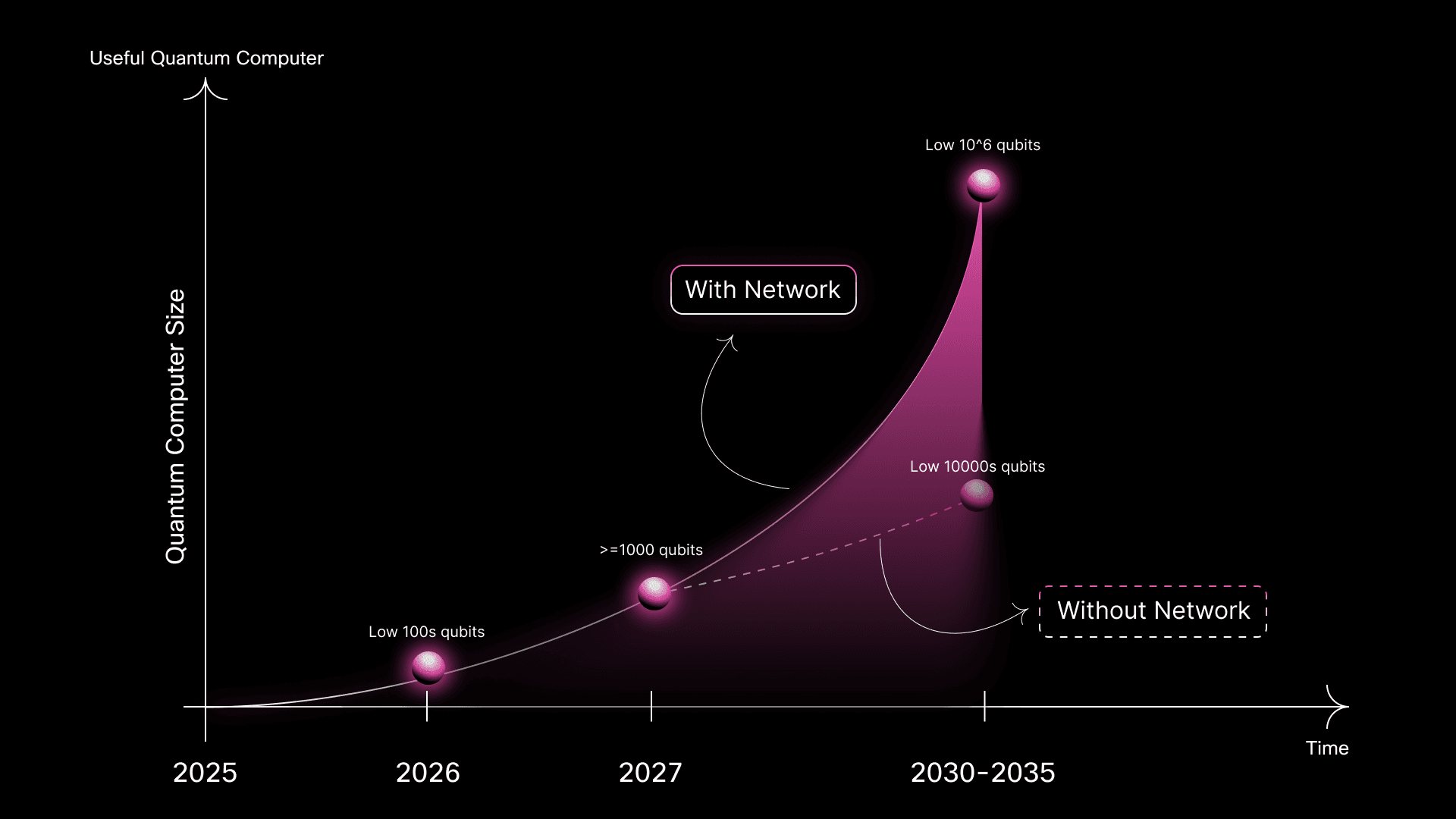
Like every major computing shift before it, the quantum internet will evolve through a series of practical advancements that build upon one another, creating value at every stage of the journey.Today, quantum principles already strengthen classical infrastructure. Eavesdropper detection, decision coordination, and true randomness deliver value now, on existing networks, ahead of any large-scale quantum computer. In the near term, rather than decades, distributed quantum data centers will bring practical, fault-tolerant quantum computing within reach by networking many processors together. In the long term, a full quantum internet will link quantum computers, sensors, and other nodes into shared infrastructure, the way the classical internet linked isolated computers into a single connected system.
At Outshift by Cisco, this means focusing not only on the long-term vision of distributed quantum computing, but also on the technologies helping organizations prepare today. By building the hardware, protocols, software, and applications that enable those connections, Outshift is constructing the bridge between today's infrastructure and tomorrow's quantum internet.
The future of quantum computing is not a single, monolithic quantum computer. It is an ecosystem of connected systems working together through a unified quantum network.
Frequently asked questions
Is quantum networking real today, or still theoretical? It is real and working, but small. Prototypes for entanglement generation, switching, orchestration, and application-layer security exist, and entanglement swapping has been validated on live metropolitan fiber. A global quantum internet is still being built piece by piece, and the components available today are research prototypes rather than shipping products.
How is a quantum network different from the classical internet? The classical internet moves copyable bits using store-and-forward and retransmission. A quantum network distributes fragile, uncopiable entangled qubits and transfers states through teleportation, which cannot copy, amplify, or retransmit. That forces an entirely new set of hardware, protocols, and software, so classical protocols such as TCP/IP do not carry over.
Do I need a quantum computer to benefit from quantum networking? No. Applications such as eavesdropper detection, decision coordination, and quantum-generated randomness deliver value on classical infrastructure today, ahead of large-scale quantum computers becoming available.
What is the relationship between quantum networking and quantum security? They overlap but are distinct. Quantum-safe practices such as post-quantum cryptography and QKD protect data against quantum-era threats, while quantum networking additionally provides physical-layer capabilities, such as the tamper detection behind Quantum Alert, that come from distributing entanglement itself.
Why can't you just build one giant quantum computer? It’s possible in principle, , but the engineering difficulty of controlling, cooling, and error-correcting a single processor grows sharply with size, and a machine large enough for the hardest problems is estimated to be a decade or more away. Networking many smaller processors is the more practical path to the same scale, and it mirrors how classical computing moved from single machines to distributed data centers and the cloud.
When will the quantum internet arrive? In stages. Near-term value exists now, distributed quantum data centers are a multi-year horizon, and a full quantum internet is a longer-term build measured in years of connected milestones rather than a single launch date.