AGNTCY was created by Outshift and is now a Linux Foundation project. This open source project is building an open, interoperable Internet of Agents—the foundational infrastructure that enables AI agents to collaborate across any framework or vendor.
Outshift launched AGNTCY in March 2025, building off the Internet of Agents vision to build an open, interoperable internet for agent-to-agent collaboration.
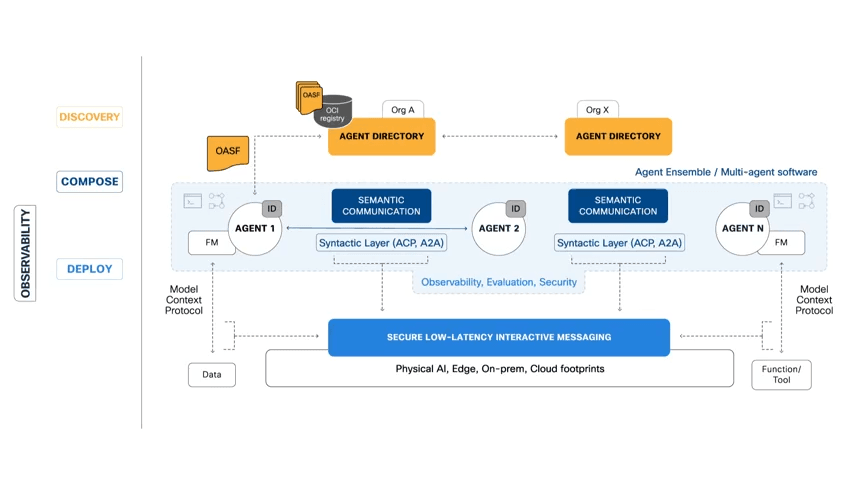
AGNTCY launched on GitHub with complete code, specifications, and services, alongside Galileo and LangChain as core maintainers. The team built the discovery, identity, messaging, and observability components that agents need to find each other, verify their capabilities, and collaborate securely..
The AGNTCY project, as an open-source community now part of the Linux Foundation, solidifies the commitment to an open and interoperable Internet of Agents.
Outshift incubated the project as a "venture builder" initiative to address the fragmentation of AI agents operating in silos. The AGNTCY name and "Internet of Agents" vision were introduced to represent a new operational approach for agent collaboration.
Outshift officially announced the AGNTCY initiative as an open-source collective launched in partnership with LangChain and Galileo.
The initial release of working code and technical specifications for the Open Agentic Schema Framework (OASF) and Agent Directory were released
Cisco officially donated the AGNTCY project to the Linux Foundation to establish neutral governance and accelerate industry-wide adoption.
Over 75 companies had joined the effort, leading to AGNTCY's donation to the Linux Foundation in July 2025 to ensure neutral governance and long-term community stewardship.
AGNTCY components and their builders have also become part of broader communities, including AAIF, the A2A protocol and the Agentic Resource Discovery (ARD) specification.
As of 2026, the ecosystem has grown to include nearly 150 members, with 6 active working groups. AGNTCY continues to have hands-on workshops and has awarded 125 workshop badges to participants so far. The technology is powering production-grade multi-agent systems in sectors such as healthcare coordination and autonomous network configuration.
Number of organizations collaborating in AGNTCY projects
Number of repositories
Number of badges awarded in 1st AGNTCY workshop
Number of attendees at first AGNTCY Summit








The agentic future should be open and distributed. At Galileo, we help organizations build trustworthy agents and scale agentic systems with confidence. We're happy to contribute frameworks and schemas for agent evaluation to this important effort.

Multi-agent systems are the future of AI, but we need open standards for both collaboration and rigorous assessment. The AGNTCY creates the foundation for a truly observable and trustworthy AI ecosystem. Our evaluation frameworks ensure agents perform reliably across diverse scenarios, empowering organizations to deploy at scale.

Interoperability is central to Dell's agentic AI vision. The ability of agents to work together empowers enterprises to reap the full value of AI. Dell is working hand-in-hand with industry leaders to establish open standards for agentic interoperability. Being a formative member of the Linux Foundation AGNTCY project is one such step towards fulfilling the promise of agentic AI.

Open, community-driven standards are essential for creating a diverse, interoperable agentic AI ecosystem. We're pleased that Cisco is moving AGNTCY to the Linux Foundation, where it will be neutrally governed alongside the Agent2Agent protocol to advance powerful, collaborative agent systems for the industry.

Enterprise customers need agent infrastructure they can trust for mission-critical workloads. We welcome AGNTCY’s move to the Linux Foundation and are proud to be a formative member of this project. A tight control over data security and governance helps discovery, identity, and observability components work reliably across the entire enterprise technology stack, not just specific vendor ecosystems.

Our customers and partners, as well as the open source communities we work with, are actively exploring agentic capabilities to bring the inferencing benefits of vLLM and llm-d to their applications. Red Hat welcomes AGNTCY's move to the Linux Foundation and we look forward to working with the community to help bring open, agnostic governance to the agentic AI ecosystem

Outshift’s accomplishments to date with Agntcy have been impressive, especially in just the few months since the collective launched.
[AGNTCY] can help give enterprises the confidence they need to press ahead with more complex agentic AI deployments.
AGNTCY launched an entire architecture for agent interoperability… These aren’t just technical implementations; they’re strategic plays for defining the architecture of multi-agent systems.


Legacy video monitoring systems struggle to deliver timely, actionable insights in complex environments like transportation hubs and public infrastructure. These systems often rely on isolated AI models or manual review, leading to missed events, delayed responses, and limited situational awareness. As demand for real-time, scalable intelligence grows, traditional architectures fall short.
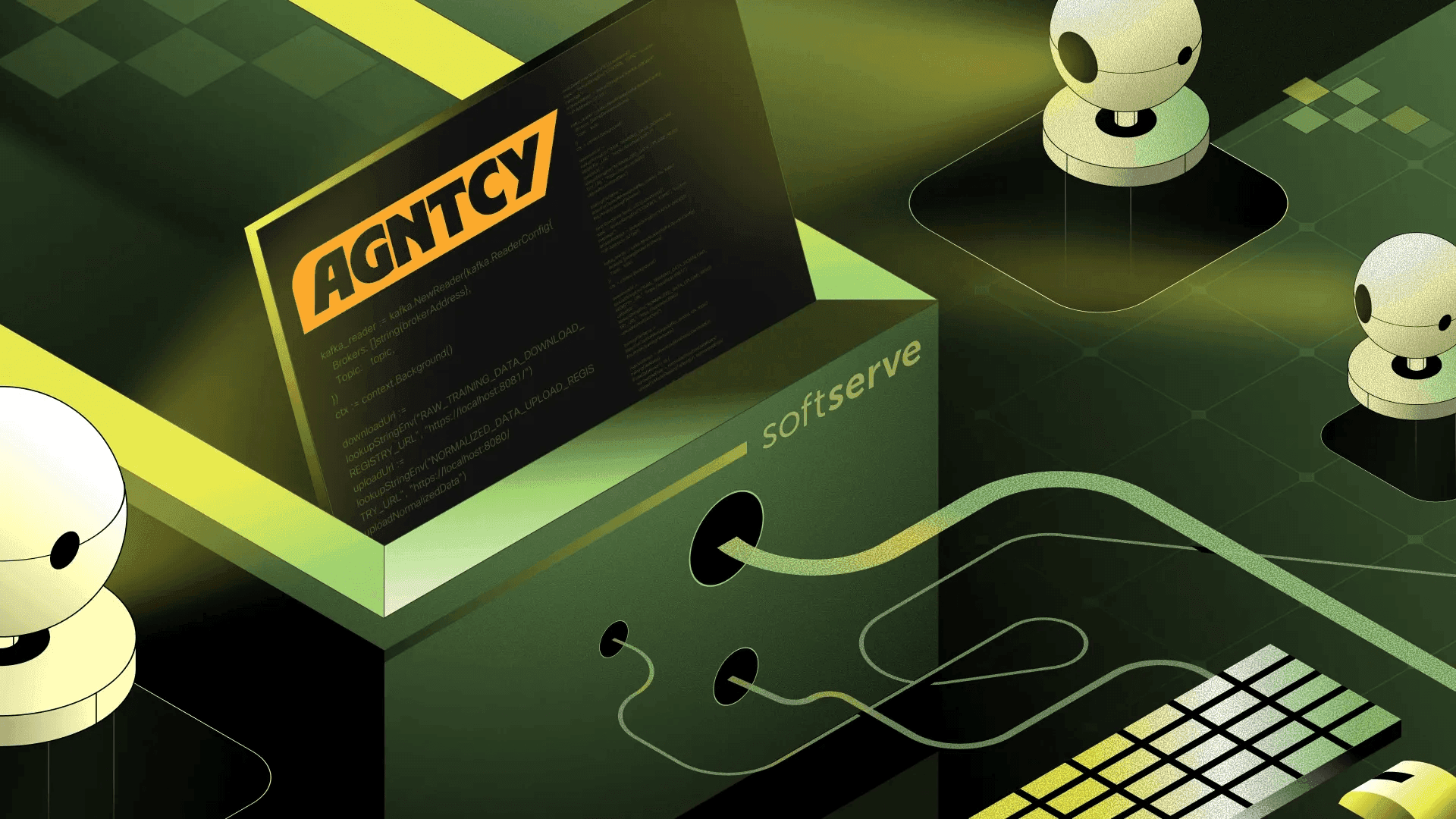
SoftServe partnered with AGNTCY to deploy a multi-agent video intelligence system powered by SLIM (Secure Low-latency Interactive Messaging). SLIM enables fast, secure communication among specialized agents that handle tasks such as object detection, behavior analysis, and alert generation. This low-latency messaging layer ensures real-time responsiveness and coordination, allowing the system to scale efficiently while maintaining semantic clarity and operational trust.

Legacy video monitoring systems struggle to deliver timely, actionable insights in complex environments like transportation hubs and public infrastructure. These systems often rely on isolated AI models or manual review, leading to missed events, delayed responses, and limited situational awareness. As demand for real-time, scalable intelligence grows, traditional architectures fall short.
SoftServe partnered with AGNTCY to deploy a multi-agent video intelligence system powered by SLIM (Secure Low-latency Interactive Messaging). SLIM enables fast, secure communication among specialized agents that handle tasks such as object detection, behavior analysis, and alert generation. This low-latency messaging layer ensures real-time responsiveness and coordination, allowing the system to scale efficiently while maintaining semantic clarity and operational trust.
Enterprises are rapidly adopting AI assistants and multi‑agent workflows, but most agentic apps remain siloed, difficult to authenticate, and hard to govern at scale. Without a unified directory or identity layer, organizations struggle to securely onboard agents, verify their trustworthiness, and enable cross‑vendor interoperability—creating fragmentation, security risk, and operational overhead across the Webex ecosystem.
Webex integrated AGNTCY Directory and AGNTCY Identity into its Agent Central Service (ACS) to establish a trusted, standards‑aligned foundation for onboarding, discovery, and verification of agentic apps. This integration provides a unified governance and security layer, enabling developers to register and publish MCP/A2A servers through the Webex Developer Portal and App Hub, while enterprises enforce policies through Control Hub. The result is secure, interoperable, and scalable multi‑agent collaboration across the entire Webex platform.
Enterprises are rapidly adopting AI assistants and multi‑agent workflows, but most agentic apps remain siloed, difficult to authenticate, and hard to govern at scale. Without a unified directory or identity layer, organizations struggle to securely onboard agents, verify their trustworthiness, and enable cross‑vendor interoperability—creating fragmentation, security risk, and operational overhead across the Webex ecosystem.
Webex integrated AGNTCY Directory and AGNTCY Identity into its Agent Central Service (ACS) to establish a trusted, standards‑aligned foundation for onboarding, discovery, and verification of agentic apps. This integration provides a unified governance and security layer, enabling developers to register and publish MCP/A2A servers through the Webex Developer Portal and App Hub, while enterprises enforce policies through Control Hub. The result is secure, interoperable, and scalable multi‑agent collaboration across the entire Webex platform.
As AI systems grow more complex—especially with multi-agent architectures—traditional observability tools fall short. They focus on infrastructure metrics like latency and error rates, but fail to capture the semantic quality of AI outputs. This leaves businesses blind to critical issues like hallucinations, incoherence, or misalignment with user intent, making it difficult to trust and scale these systems in production.
AGNTCY and Splunk are redefining AI observability by embedding agentic semantic conventions into OpenTelemetry. Their Metrics Compute Engine (MCE) combines infrastructure metrics with LLM-based evaluations of output quality—like factual accuracy and coherence—giving teams a holistic view of system performance. This open, interoperable approach enables real-time diagnostics and trust at scale, paving the way for robust multi-agent deployments.

As AI systems grow more complex—especially with multi-agent architectures—traditional observability tools fall short. They focus on infrastructure metrics like latency and error rates, but fail to capture the semantic quality of AI outputs. This leaves businesses blind to critical issues like hallucinations, incoherence, or misalignment with user intent, making it difficult to trust and scale these systems in production.
AGNTCY and Splunk are redefining AI observability by embedding agentic semantic conventions into OpenTelemetry. Their Metrics Compute Engine (MCE) combines infrastructure metrics with LLM-based evaluations of output quality—like factual accuracy and coherence—giving teams a holistic view of system performance. This open, interoperable approach enables real-time diagnostics and trust at scale, paving the way for robust multi-agent deployments.

Enterprises want to run multi‑agent systems across cloud, data center, and edge environments, but today’s infrastructure makes it hard for agents to coordinate, maintain low latency, and stay observable across distributed locations. As AI workloads scale, teams struggle with where to place inference, how to connect agents across sites, and how to monitor non‑deterministic behavior end‑to‑end.
Digital Realty deployed coffeeAGNTCY—an open‑source, multi‑agent demo app that showcases how agents communicate, coordinate, and complete tasks using AGNTCY standards—across two Cisco AI Pods to demonstrate real‑world, hybrid agentic AI. By pairing this reference implementation with Digital Realty’s interconnected infrastructure, the deployment shows how enterprises can run reasoning in the cloud, execute on‑prem, and maintain unified observability across all agents. The result is low‑latency coordination, secure cross‑cluster communication, and a practical blueprint for scaling distributed multi‑agent systems.

Enterprises want to run multi‑agent systems across cloud, data center, and edge environments, but today’s infrastructure makes it hard for agents to coordinate, maintain low latency, and stay observable across distributed locations. As AI workloads scale, teams struggle with where to place inference, how to connect agents across sites, and how to monitor non‑deterministic behavior end‑to‑end.
Digital Realty deployed coffeeAGNTCY—an open‑source, multi‑agent demo app that showcases how agents communicate, coordinate, and complete tasks using AGNTCY standards—across two Cisco AI Pods to demonstrate real‑world, hybrid agentic AI. By pairing this reference implementation with Digital Realty’s interconnected infrastructure, the deployment shows how enterprises can run reasoning in the cloud, execute on‑prem, and maintain unified observability across all agents. The result is low‑latency coordination, secure cross‑cluster communication, and a practical blueprint for scaling distributed multi‑agent systems.